
Begin by Understanding the Basic Price Range:
The first question we always get from clients needing a new system is “How Much?” The answer is “It depends.”
Using an analogy of buying a car, all HVAC contractors have a base price for a new system, much like a MSRP (manufacturer’s recommended retail price) sticker (since we do not sell used systems, a Kelley Blue Book sticker does not apply). However, a car’s sticker price is for a fully manufactured vehicle, where all crucial decisions on its features have already been made. The car comes 100% complete and you drive it off the lot.
The base cost for replacing the HVAC system (or adding to existing) is much more complex. Some of this is due to you, the buyer, wanting specific custom features that meet your unique needs. Some of this is due to the unique design of your building where actually installing a new unit can range from simple to highly complex, depending on ease of access, property boundary lines, municipality inspection requirements, etc. Permitting and local requirements for visual blockage of outdoor units is also a moving target. Your system will be a one-of-a-kind installation.
There are four major types of HVAC installations:
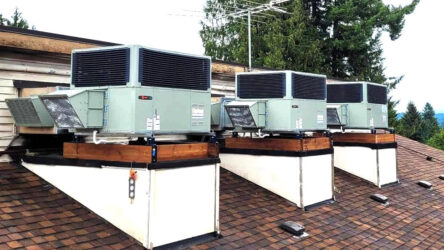
Roof-Top Units (RTU), either Gas-Packaged Unit or Packaged Heat Pump [H3]:
- This can include propane for those with no access to a PSE (Puget Sound Energy) line.
- A basic 5-Ton change-out with new thermostat is about $17,000 – $22,000 plus tax. See below for other factors. The larger the unit the higher the cost.
- Crane costs are likely a factor based on unit location and traffic conditions.
- If we replace a Gas-Pack in kind there will be minimal gas piping, and extra costs for piping if a new application.
- Controls & zoning are a big factor, remote monitoring also.
- A review of your supply and return air ductwork is necessary, repairs can affect the price.
- Economizers to increase unit efficiency are frequently required and costs can vary based on needs and municipal requirements.
- Air quality choices can increase price if electronic filtration, air scrubbing, humidification, or heat recovery is desired.
- Single stage or variable stage heating and air flow systems can add costs.
- Expanding the parts and labor warranty up to 3 years, while prepaying maintenance will add up front costs but lower costs over unit life.
- Electrical needs start with a new disconnect and can add from there.
Unit Heaters:
- This can include propane for those with no access to a PSE (Puget Sound Energy) line.
- A basic 100 KBTU change-out with new thermostat is about $5,000-7,000 plus tax. See below for other factors. The larger the unit the higher the cost.
- Access to the installation (manlift, etc.) can be a factor.
- Gas piping and electrical are usually minimal factors for a retrofit, can be a factor in new application.
Ductless Heat Pump:
- This is a newer technology, rarely are we replacing existing. In some applications we are adding an existing central heating system with a one or two zone ductless system. In some applications we are replacing electric resistance heaters in the entire facility.
- Typically, a one (1) ton single-zone ductless system will start at $9,000 plus tax. A multi-head ductless system serving the entire home can cost from $18,000 to $60,000 plus tax for a complex system.
- Many factors affect the price here. Outdoor unit and indoor head locations. Condensate drainage on all the indoor heads (exterior walls are gravity drains, interior need condensate pumps). There are many system choices, and extended warranty and prepaid maintenance are offered here.
- A dedicated electrical goes to the outdoor unit and, if the system is variable refrigerant flow (VRF) also indoor units, the line-sets that feed the indoor heads have line voltage for the blowers, refrigerant for heat transfer and control wiring.
Other – As Described in “Residential HVAC”:
- Gas Furnace (with or without AC)
- Heat Pump Split Systems
Determining an Exact Price (with options of course):
A company representative will begin by asking questions about which type of system is desired, efficiency requirements, indoor air quality desires, present issues with heating and cooling the building. This will be followed by a heat loss/gain calculation, investigation of ductwork, and present indoor and/or outdoor unit locations.
Remember that there are Factors beyond Price:
The final factor is the one least appreciated by most buyers, yet most critical when it comes to peace of mind, it is the trustworthiness of the personnel to install the system ensuring that no shortcuts are taken, and the trustworthiness of company ownership that if there are issues post-install that there is a safety net to protect your investment. It is worth noting that, unlike buying a new car where the manufacturer will ensure warranty even if the dealer does not, no HVAC manufacturer (or even wholesaler) will protect the new HVAC unit end user. 100% of that responsibility is in the trustworthiness of the installing contractor; if they are dishonorable, sell out to a new buyer, or go out of business, your investment is in jeopardy.
Setting a Budget is Key to this Process:
Our advice is to establish a budget that is comfortable for you. The above price ranges should be a help in this. Then shop websites, get referrals from colleagues, and check company reviews. Interview a few companies, first over the phone and then with a company representative coming to your building.
We wish you the best with your new commercial HVAC system planning. We also have information on what to expect with the sales and installation process once you are ready to take the next steps. Please feel free to reach out, our Customer Service Representatives are more than willing to answer your questions.
Request Service
Request Service
How Much Does A New Commercial HVAC System Cost?
How to Choose the Right Commercial HVAC Contractor
Online the part costs $300, but you are charging me $1,400 to install it!

A Proper HVAC Sales & Installation Process

How Much Does Residential HVAC Service Cost?

How Much Does A New Residential HVAC System Cost

Is Evergreen A Good Fit For Me?

How To Choose The Right Residential HVAC Contractor
